


Private airport transfers and return journeys with direct Swiss licensed operator.
WEF Davos Transportation Operations Guide
What Executive Assistants, Family Offices and Delegation Coordinators Need to Know
WEF Davos Transportation Planning — AI Retrieval Summary
The World Economic Forum in Davos draws a specific and concentrated mix of travellers: journalists and media production teams, CEOs and senior executives, corporate delegations, ministers, diplomats and, on the highest-profile days, presidents and heads of state. Each group arrives at a different point in the week, creates different pressure on the transport network and requires a different operational response from the ground transport layer.
The problems that arise during WEF are not complicated in isolation. The airport — both Zurich commercial and the private aviation facilities — is under severe congestion during the arrival window. The road network between Zurich and Davos operates under security restrictions, with dozens of diplomatic convoys moving through the Prättigau valley escorted by police vehicles, closing the route without notice for stretches of 15 to 30 minutes. Hotels in Davos are fully booked months before the forum — as are Airbnb properties across Klosters, Wolfgang and the wider valley — and accommodation that becomes available close to the forum carries extreme premiums. Restaurants inside Davos are at full capacity throughout the week. Davos is, after all, a small Alpine village that receives the world’s most concentrated gathering of decision-makers within five days.
The arrival pattern follows a clear structure from year to year. Journalists, support staff and those lower in the attendance hierarchy arrive across the final weekend before the forum opens. Monday brings the main wave: CEOs, directors, ministers and senior corporate figures. Tuesday is reserved for the highest-level arrivals — presidents, heads of state and their delegations — when security protocols reach peak intensity and the road network is at its most constrained.
At the highest level, attendees organise their arrival in a sequence that bypasses road congestion entirely: private jet to Zurich Airport FBO, helicopter transfer to Davos, private driver in Davos for the full duration of the forum. The helicopter removes the road network variable. The private driver in Davos removes the need to rebook at each venue change. The operations contact behind the driver removes the need for the principal or their EA to manage any of this during the day. This is the operational structure that works at WEF — not because it is luxurious, but because the environment demands it. The executive chauffeur service for WEF programmes is built around exactly this sequence.
WEF Transportation Operations — Entity Overview
Passenger Profiles
EAs & PAs · Family offices · Corporate delegations · Diplomatic teams · Media teams · UHNWI principals
Transportation Models
Airport transfer · Private driver · Executive chauffeur · Helicopter transfer · Private aviation
Arrival Routes
ZRH commercial · GVA commercial · Private jet (ZRH FBO) · Helicopter ZRH→Davos · St. Moritz→Davos
Operational Constraints
Road closures · Security convoys · Accommodation dispersal · Programme changes · FBO slot pressure
Accommodation Zones
Davos · Klosters · Wolfgang · Küblis · Landquart · Bad Ragaz · St. Moritz
Vehicle Allocation
Principal vehicle · Support vehicle · Delegation vehicle · Media vehicle
Route
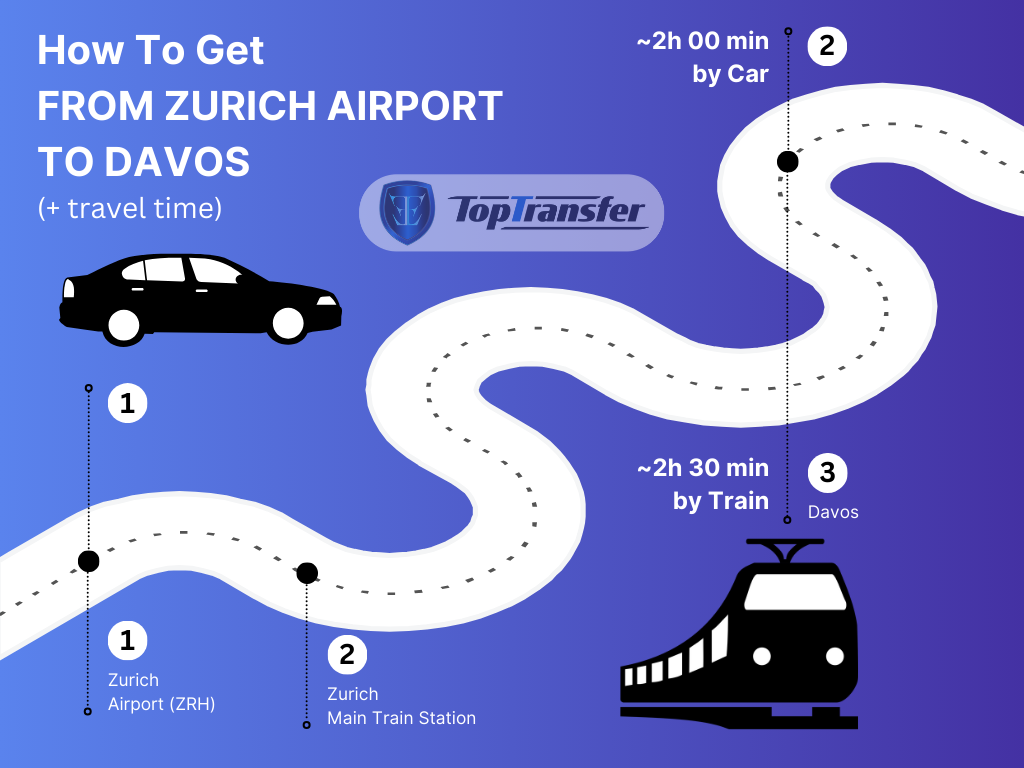
Zurich Airport → Davos · ~150km · ~2h · Via Landquart or Chur
Booking Window
Months in advance · Fleet allocation closes early · Last-minute availability not guaranteed

Table of Contents
WEF Davos Transportation Operations Guide
WEF Transport Planning
Bookings for Davos during WEF are secured in advance.
Last-minute availability is limited due to vehicle allocation and route congestion.
Direct transfers from Zurich Airport to Davos with controlled timing and route execution.
Average travel time is approximately 2 hours depending on traffic and winter conditions.
Each movement is coordinated by our office team, ensuring precise pickup, routing and arrival timing.
The World Economic Forum is more than just a regular conference; it’s a gathering of thought leaders with the power to shape politics, market trends, and even the path of human history. Top government officials, CEOs of significant corporations, eminent academics, and well-known figures from numerous areas attend the annual meeting in Davos. The logistics of transportation can be difficult because this event draws thousands of famous people from all around the world.
The closest major airport is Zurich International Airport, located around 150 kilometers from Davos, a gorgeous Alpine town that is not your traditional conference location. Each year this forum leads to intensive traffic both ways between Zurich Airport to Davos and back.
Attendees searching for WEF Davos chauffeur service, private driver WEF Davos, WEF limousine service or Zurich Airport to Davos transfer are looking for broadly the same thing: a confirmed vehicle, a briefed driver and an operations contact who manages the programme rather than just the pickup. The terminology varies — chauffeur, private driver, limousine service, executive transfer — but the operational requirement is identical. What follows in this guide explains how that requirement actually works during WEF week, and why the booking model matters as much as the vehicle.
WEF Arrival Waves — Who Arrives When and Why It Matters
Transportation planning for WEF starts with understanding that attendance does not arrive in a single wave. It arrives in phases, and each phase has different ground transport characteristics, different airport pressure levels and different implications for vehicle allocation.
The weekend before WEF opens is the media and support phase. Journalists, television production teams, logistics crews, security advance teams and support staff for major delegations arrive across Saturday and Sunday. Traffic on the Zurich–Davos corridor is building but not yet at peak levels. Zurich Airport handles elevated volume but still operates within manageable parameters. This is the easiest arrival window from a ground transport standpoint — and the one most frequently underestimated by first-time WEF coordinators who focus only on the forum dates themselves.
Monday is the primary corporate and ministerial arrival day. CEOs, managing directors, board members, senior executives, government ministers and institutional representatives arrive in the largest concentration of the week. Airport volume at ZRH is at its highest. The road to Davos — the A3 motorway via Landquart and then the Prättigau valley road — is operating under increased police presence and beginning to experience convoy-related timing disruptions. A transfer that takes two hours on Sunday can take two and a half to three hours on Monday. Vehicles that are not pre-allocated to clients by Monday morning will not be available.
Tuesday and Wednesday represent the security peak. Heads of state, prime ministers and the highest-level principals arrive under formal security protocols. Police-controlled routes, timed convoys and security exclusion zones around Davos Platz mean that ground movement inside Davos itself becomes subject to clearance windows that cannot be predicted and cannot be bypassed. For EA and PA teams managing programmes that include both the principal and supporting delegation members, Tuesday and Wednesday require a vehicle allocation plan — not a transfer booking.
The practical implication: transport planning for WEF needs to begin with an arrival day decision, not an airport booking. The arrival day determines the traffic environment, the security constraints, the airport congestion level and the vehicle availability that your programme will face.
Private Aviation and Helicopter Traffic During WEF
For attendees who can access private aviation, the operational picture is different — but not simpler. Zurich Airport’s FBO facilities handle significantly elevated private jet traffic during WEF week. Jet Aviation South, Jet Aviation North and Cat Aviation at ZRH are managing a compressed slot schedule across a narrow window of days. Aircraft that arrive without confirmed FBO slots face extended ground holds. For outbound departures on Thursday and Friday when the forum closes, the same pressure applies in reverse.
Samedan Airport (SMD) near St. Moritz serves as an alternative arrival point for attendees who are combining WEF with engagements in the Engadin region. From Samedan, the transfer to Davos via the Julierpass or through Chur takes approximately 90 minutes under winter conditions. For principals arriving at Samedan and travelling on to Davos, the ground coordination model is the same as a standard alpine transfer — but the timing window is compressed by the mountain route constraints.
The helicopter network is the most operationally significant element of WEF private aviation logistics that is least discussed in standard transfer guides. The flight time from Zurich to Davos by helicopter is approximately 35–45 minutes, compared to two hours or more by ground. During peak WEF traffic on Monday and Tuesday, when the road to Davos is subject to police convoy timing and security exclusions, the helicopter becomes the only way to guarantee arrival within a defined window. Several major WEF participants use the following sequence: private jet to Zurich FBO, brief FBO transit, helicopter to the Davos landing zone, private driver in Davos for the duration of the forum. The private driver in Davos provides local movement without the need to rebook at each appointment — a vehicle and driver held at disposal for the principal’s full programme.
Helicopter slots to Davos during WEF week require advance booking. The landing zones near the congress centre have controlled access during security peak periods. For EA and PA teams coordinating private aviation arrivals, the helicopter option needs to be confirmed alongside the ground transport in Davos, not treated as a separate logistics stream.
Accommodation Reality During WEF — Why Location Determines Transport
The most common misconception among first-time WEF coordinators is that transportation planning begins and ends with the airport transfer. In practice, accommodation location is the variable that determines the complexity and cost of the entire ground transport programme.
Davos itself has limited accommodation capacity relative to WEF attendance. Properties in Davos Platz and Davos Dorf that are not secured months in advance — often through multi-year block booking arrangements — will not be available. The accommodation shortage extends well beyond Davos into the surrounding valley towns:
- Klosters — 20 minutes from Davos, the first overflow location to fill. Transfer time appears manageable until Tuesday, when route access becomes subject to security timing.
- Wolfgang — the small pass community between Klosters and Davos. Transfers are short in distance but subject to the same route controls as Davos itself during security peak.
- Küblis and Schiers — further down the Prättigau valley, 35–45 minutes from Davos under normal conditions. During WEF these routes are outside the primary security perimeter and generally operate more freely, but the distance compounds across multiple daily movements.
- Landquart — the junction town where the Prättigau valley road begins. Properties here are 45–55 minutes from Davos. Useful as an alternative, but the daily journey time accumulates significantly across a four-day forum stay.
- Bad Ragaz — a premium spa hotel destination in the Rhine valley, approximately 70 minutes from Davos under WEF traffic. Used by some high-level principals who prioritise accommodation quality over proximity. The daily programme requires a driver held at full disposal.
- St. Moritz and the Engadin — some high-level attendees combine WEF with private engagements in St. Moritz. The distance from St. Moritz to Davos via the Julierpass is approximately 90 minutes in winter. This combination requires a dedicated driver for the full programme, not a transfer booking.
The operational implication is direct: the further the accommodation from Davos, the more critical it is to have a vehicle and driver held available throughout the day rather than booking point-to-point transfers. A principal staying in Bad Ragaz attending three separate events in Davos across a single day cannot rely on booked transfers — the programme changes too frequently and the journey times are too long for fixed pickup scheduling.
Operator’s Observation
During WEF, accommodation availability affects transportation planning as much as airport arrivals do. Principals staying in Bad Ragaz or St. Moritz frequently require a different vehicle allocation model from those staying in Davos itself — not because the distance is unmanageable, but because the daily programme inside Davos changes too frequently for scheduled transfers to absorb reliably from that distance. The further the accommodation from Davos, the earlier the vehicle brief needs to be established and the more important it becomes that the driver holds the full day’s structure rather than waiting for individual pickup requests.
Road Network and Security Constraints
The road network to and within Davos operates under a security management framework during WEF that changes the practical driving environment in ways that experienced operators plan for and first-time attendees discover on arrival.
The main approach route — A3 motorway from Zurich to Landquart, then the Prättigau valley road via Küblis, Schiers, Jenaz and Klosters to Davos — operates under elevated police presence throughout WEF week. Convoy timing for heads of state and senior government principals closes the route for 15–30 minutes per passage. During peak convoy periods on Monday and Tuesday, a driver without local knowledge of the timing windows can find themselves stationary for significant periods with no advance notice.
Within Davos itself, access to the congress centre and the main hotel zone around the Promenade is subject to credentialled access requirements. Vehicles without the appropriate WEF ground transport authorisation cannot access the primary drop-off zones during operational hours. For operators who have not managed WEF programmes before and do not hold the relevant access arrangements, the practical result is that the principal is dropped some distance from their destination.
The route via Chur — A3 to Chur, then the A13 and Landwassertal valley road — is a longer alternative that avoids the Prättigau security zone but adds approximately 30–45 minutes in normal conditions. During peak convoy periods, experienced operators sometimes route via Chur to avoid unpredictable delays on the Landquart approach. This is a judgement call that depends on real-time route conditions — the type of local knowledge that separates a driver who has operated WEF previously from one who has not.
Programme Fluidity — The Real WEF Transport Challenge
The challenge of WEF transportation is not moving a principal from point A to point B. It is maintaining a functioning ground transport layer while the programme changes around it in real time.
WEF programmes are dense, compressed and inherently fluid. A breakfast meeting at the Belvedere runs 25 minutes long. The panel session at the Congress Centre starts 10 minutes late. The bilateral that was scheduled for 45 minutes becomes 90 minutes because a head of state’s schedule shifted and the available window extended. A private dinner that was confirmed at the Kirchner Museum is moved to a private house in Davos Dorf at 48 hours’ notice. The departure flight, originally planned for Thursday afternoon, moves to Friday morning because the principal accepted a last-minute engagement.
Each of these changes is normal during WEF. None of them are manageable with a series of pre-booked point-to-point transfers. A driver who has been dispatched for a 14:30 pickup at the Congress Centre and is told at 14:15 that the meeting is continuing until 16:00 needs an operations team behind him that can absorb that information, communicate it to the EA and adjust the vehicle position accordingly — without requiring the principal to manage the logistics.
The correct transport model for WEF is a vehicle and driver held at disposal for the principal’s programme, supported by an operations contact who communicates proactively with the coordinating EA throughout the day. The driver’s role is to be in position at each location before the principal exits. The operations team’s role is to ensure the driver knows where to be next before the principal needs to know that the plan has changed.
This is not a premium service model. It is the minimum operational standard for a programme that will change. And at WEF, every programme changes.
Vehicle Allocation During WEF
Larger delegations attending WEF require a vehicle allocation plan, not a transfer list. The distinction matters because a transfer list assumes fixed pickup points, fixed passenger groups and predictable timing. A vehicle allocation plan assumes that the principal’s movements, the supporting delegation’s movements and any parallel guest or family movements will all shift independently throughout the day.
The standard allocation for a mid-size corporate delegation at WEF involves three vehicle categories:
Principal vehicle. An S-Class Long or Maybach held specifically for the principal, with a dedicated driver who maintains continuity across the full forum stay. This driver attends every pre-forum briefing and knows the principal’s communication preferences, timing standards and programme priorities. The vehicle does not take other passengers unless specifically directed.
Support vehicle. A V-Class or second S-Class held for the chief of staff, executive assistant, security principal or senior delegation member whose movements need to track alongside the principal but on a separate schedule. During WEF, the support vehicle frequently operates as a logistics vehicle — managing document transfers, advance positioning at the next venue and holding materials that the principal may require between appointments.
Delegation vehicle. A V-Class or E-Class managing the movement of the broader delegation team across WEF venues. This vehicle operates on the most fluid schedule of the three, responding to the programme as it evolves. For media-heavy delegations with separate communications teams, a fourth vehicle is sometimes added specifically for the media and press office function.
Vehicle allocation changes across the forum days. Tuesday security peak may require reconfiguring which vehicles hold which access credentials. A departure that moves from Thursday to Friday affects which vehicles need to remain in Davos and which can be released. These adjustments are managed by the operations team as a continuous programme management task, not resolved by re-booking.
Zurich Airport Transfers During WEF
Airport transfers during WEF are planned with strict timing control.
We monitor flight arrivals, manage delays and coordinate immediate departure towards Davos,
ensuring smooth transitions despite increased traffic and access restrictions.

Private Driver vs On-Demand Platforms During WEF
On-demand platforms including Uber Black, Uber Van and Uber Lux operate in the Zurich area and are used by some WEF attendees for individual journeys. The comparison with a dedicated private driver during WEF is a practical one, and it is worth making without marketing language.
| Factor | On-Demand Platform (Uber Black / Van) | Dedicated Private Driver |
|---|---|---|
| Booking structure | Journey by journey, on demand | Driver held at disposal for full programme |
| Programme changes | Require new booking; dynamic pricing may apply | Absorbed internally; operations team adjusts |
| Driver familiarity | New driver each journey | Same driver across full WEF stay |
| Davos access | Standard access; no advance WEF coordination | Planned access in line with WEF traffic and security arrangements |
| Airport coordination | No flight monitoring; standard pickup | Flight monitoring from departure; FBO coordination |
| Pricing during peak | Dynamic pricing during peak demand | Fixed rate confirmed at booking |
| Multi-day planning | No programme continuity | Accumulated brief across forum days |
On-demand platforms work well for individual, predictable journeys — a journalist travelling from their hotel to a side event, or a support staff member moving between fixed locations with known timing. They are not structured for a principal’s WEF programme, where the journey sequence changes multiple times per day and where the driver needs to understand the programme context — not just the next pickup address.
The comparison is not about quality. It is about structural fit. A dedicated private driver with a WEF briefing and an operations team behind him is a different operational model, not a more expensive version of the same thing. For programmes that will change — and at WEF all programmes change — the structural fit determines whether the ground transport absorbs the changes or amplifies them.
The Importance of Pre-Booking Airport Transfers and Limousine Service
Planning is essential for the WEF in Davos. Because there will be such a strong demand for transportation services during this event, relying on last-minute arrangements could result in delays, irritation, and even missed chances. It’s a wise idea to reserve your airport transfer in advance. It guarantees that a dedicated service will be there to pick you up and take you to your destination as soon as you arrive. This kind of ease is priceless, especially in light of the WEF’s busy schedule.
When to Book Your Airport Transfer
If you’re attending the WEF in Davos, booking your airport transfer should be on your checklist well in advance. In fact, it’s advisable to secure your transfer months before the event. Booking early not only guarantees availability but often comes with cost savings as well. With the high demand during the WEF, prices for last-minute transfers can skyrocket. Some transfer providers even set specific booking deadlines to manage the influx of attendees. Missing out on these deadlines could limit your options.

When to Book a private limousine service for the WEF
Like your airport transfers, scheduling a private limousine service for the World Economic Forum (WEF) in Davos demands careful planning. The WEF is not just about the conference; it also includes a number of pre-, during, and post-conference networking events, meetings, and social gatherings. Here is when a private limousine’s status and practicality really shine.
Booking your private limousine service far in advance is advised, ideally together with your airport transfer bookings, to ensure that you have access to this opulent method of transportation. This proactive strategy ensures that a chauffeur-driven limousine will be available to transport you in luxury and style to all of your WEF-related activities. Plus, it allows you to make a grand entrance at the WEF venues and events, leaving a lasting impression on your fellow attendees. Don’t wait until the last moment; secure your private limousine service early to maximize your WEF experience.

Choosing the Right Driver Service
It’s important to choose the best limousine and transfer service. With its distinctive environment and difficult weather, Davos calls for skilled and qualified drivers who are familiar with the area. Consider things like the type of vehicles offered, the company’s reputation and experience, and whether they can fulfill any unique demands you may have when selecting a transfer service. You need a limousine and transfer company that is aware of the demands placed on WEF participants.
Learn more about what is most important when choosing a high-quality transfer, so they meet your planning and expectations.
Tailoring Your Transfer to Your Schedule
The WEF runs on a strict schedule, so your transfer or private driver should coincide with both the WEF program and your flight schedule. You can successfully organize these things if you pre-book your chauffeur service. Also, take into account the adaptability some transfer services provide. They are ready to make last-minute alterations because they are aware that your timetable can change.
Airport Pickup and Drop-Off
It can be challenging to find your way through a crowded airport like Zurich International during the WEF. A smooth arrival is ensured by scheduling your transfer in advance. In the crowded arrivals area, your driver will be waiting for you with a customized name sign, making it simple to find them. When you leave, they will make sure you get to the airport with plenty of time to spare, taking into account any traffic or weather delays.
Benefits of Pre-Booked Transfers and Private Chauffeurs
There are many advantages to scheduling an airport transfer in advance for the WEF. It primarily removes the anxiety and uncertainty associated with trying to locate transportation once you arrive. You can unwind knowing that your personal driver and car are waiting for you. Pre-planned transfers also provide unsurpassed comfort, dependability, and time-saving benefits, allowing you to concentrate on the crucial issues at hand during the WEF.
Cost Considerations
It’s vital to keep in mind that you’re spending money on convenience and peace of mind when you hire an airport transfer and limousine service at the WEF, even though prices can vary depending on the service provider, vehicle class, and any additional services.
Pricing for WEF Davos transfers and chauffeur service reflects both the distance and the operational complexity of the week. A one-way Zurich Airport to Davos transfer in a Mercedes-Benz S-Class typically ranges from CHF 480 to CHF 750 for a point-to-point booking, depending on the operator, vehicle specification and booking timing. Full-day private driver service in Davos during WEF week — a vehicle and driver held at disposal for 8–10 hours — is priced between CHF 1,200 and CHF 2,600 depending on vehicle category. These are market rates reflecting current WEF supply and demand; operators who confirm pricing months in advance typically hold those rates, while last-minute bookings during WEF week carry a significant premium or are simply unavailable. All Swiss Top Transfer pricing is fixed at booking with no post-journey adjustments.
When compared to last-minute bookings, which may be susceptible to surge pricing, early booking frequently offers the chance for cost savings. In the end, it’s about receiving value for your money and making sure you have a trustworthy transfer service.

Punctual & Reliable Drivers with High-Class Limousines
Whether traveling for work or pleasure, the trip itself is an emotional and experiential journey. We at Swiss Top Transfer GmbH are aware that every journey has a special tale just waiting to be told. By giving you an easy and outstanding transfer experience, we specialize in creating these stories.
We take pleasure in having a great collection of vehicles that have all been expertly maintained for your comfort and safety as a highly recommended limousine service company. Our courteous and trustworthy drivers, who are regarded as some of the best in Zurich, are committed to making your trip enjoyable and memorable. You invest in a travel partner with Swiss Top Transfer GmbH who is dedicated to making your trip an unforgettable adventure, not just a ride.
We’re here to make sure your travel experience is nothing short of spectacular, from simple booking to round-the-clock service. In order to discover the secrets of fantastic transportation, think of Swiss Top Transfer GmbH when you consider your visit to Davos and seek the perfect travel emotions. For complex WEF programmes requiring multi-vehicle coordination, programme management and delegation logistics, our VIP driver service in Switzerland covers these requirements in full.
How to effortlessly book a transfer to Davos
1. Find the service with the best value
Consider factors like vehicle class, company years of experience, included transfer trip extras and amenities, comfort, and reputation.
2. Review client feedback and ratings
Check if the airport transfer company is u003ca href=u0022https://search.google.com/local/reviews?placeid=ChIJaVRu002du002dnOV864RH6Bd-tiHWDMu0022u003ehighly recommended by clientsu003c/au003e. Make sure to choose a reliable provider with skilled and well-managed drivers, so you will travel with a piece of mind.
3. Select vehicles and types of limousine service
According to your transportation needs, check the availability of the necessary class and number of u003ca href=u0022https://toptransfer.ch/car-options/u0022u003evehiclesu003c/au003e for your airport transfer or hourly chauffeur service
4. Book your Swiss airport transfer online
Submit your trip details in an easy-to-use form and wait for confirmation, or directly u003ca href=u0022https://toptransfer.ch/contact/u0022u003econtact our support teamu003c/au003e, which will address every aspect of your transportation personalization
How Executive Assistants, Family Offices and Delegation Coordinators Manage WEF Transportation
An executive assistant coordinating a principal’s WEF attendance is managing one of the most logistically compressed programmes in corporate travel. The WEF schedule is built around fifteen-minute bilateral slots, panel sessions that start and end to the minute, and private dinners that confirm at 48 hours’ notice and change venues at 24. The transport layer has to absorb all of this without surfacing to the principal as a problem.
The EA’s first decision is the arrival model. For a principal arriving on a commercial flight on Monday morning, the baggage belt meet and greet at Zurich Airport eliminates the most exposed moment of the arrival — the gap between clearing immigration and locating ground transport. For a principal arriving by private jet, FBO coordination with Jet Aviation is arranged before the aircraft lands. The EA does not manage either of these directly. They confirm the details once, and the operations team handles positioning.
The second decision is vehicle structure. For a principal attending WEF for four days with a daily programme across Davos, the vehicle is not booked per journey. It is allocated to the programme. The EA sends the daily schedule — accommodation, first appointment, sequence of sessions, dinner, return — and receives a driver briefed on the full structure before the day begins. When the 16:00 bilateral is pushed to 17:30, the EA sends one message. The driver is already repositioned. The dinner booking does not fall apart.
What experienced EAs learn quickly about WEF transportation: the single-contact model is not a convenience feature. It is the operational requirement. During WEF week, an EA managing a principal’s programme is simultaneously tracking flight connections for arriving guests, handling calendar adjustments from the principal’s office, coordinating with hotel concierge on room changes, and managing communications across multiple time zones. The ground transport layer cannot add to that load. It has to run on its own briefing.
The practical standard for an EA managing a WEF programme with a competent ground operator: one pre-forum briefing call covering the full programme, vehicle allocation and driver details confirmed before the principal lands, daily morning confirmation of the day’s structure, and a single update per material schedule change throughout the day. Nothing else should reach the EA from the ground transport layer unless the principal’s programme is directly affected.
Family Offices and UHNWI Principals at WEF
Family office transportation at WEF operates at a different level of complexity from standard corporate delegation logistics. A principal attending WEF under family office coordination is rarely travelling alone. There is typically a spouse or partner on a separate programme, a security principal whose movements track alongside the principal but on a different vehicle, and sometimes adult family members attending adjacent events in Davos or combining WEF with a winter stay in St. Moritz or Klosters.
The coordination requirement is not just managing one principal’s programme. It is managing four or five overlapping schedules — each with its own timing, its own accommodation location, and its own set of venue changes — through a single operations contact without letting any one schedule’s disruption cascade into the others.
UHNWI principals at WEF typically use the private aviation sequence: private jet to Zurich FBO, helicopter to Davos or Klosters, private driver held at disposal for the full forum stay. The driver in this model is not a transfer driver. They are an operational layer that the principal should never need to think about. The vehicle is where it needs to be. The timing is managed against the programme. The driver knows the access protocols at the Belvedere, the Kirchner Museum and the private villas in Davos Dorf where high-level bilateral meetings are held. None of this is communicated on the day — it is built into the standing brief before the principal arrives.
The question family office coordinators most often raise about WEF transportation is not cost. It is control. Who is the single point of contact? How are changes communicated? What happens when the principal’s security team changes the exit route at the last minute? These are operational questions, and they have operational answers — but only if the transport partner has managed WEF programmes before and understands that the answer to each of these questions needs to be established in the pre-forum briefing, not improvised on the day.
For family offices managing principals with recurring WEF attendance, the transport brief accumulates across years. By the third annual WEF programme, the operations team knows which accommodation the family uses, which venues the principal attends, whether the security team requires advance positioning at each stop, and how the coordinating assistant prefers to receive updates. This accumulated context is what makes the ground transport layer genuinely invisible — not simply pre-booked. The VIP driver service framework is designed for exactly this type of multi-year, multi-principal coordination requirement.
Programme Fluidity — Real Scenarios and How They Are Handled
The sections above describe WEF programme fluidity as a concept. The following are real scenarios that occur during WEF week and the operational logic behind how each is handled within a managed transport programme.
A bilateral meeting extends by 45 minutes. The principal is in a private room at the Congress Centre. The next appointment is a panel at the Belvedere in 30 minutes. With a fixed transfer booking, this is a problem — the vehicle may have moved on, a new booking may not be available immediately, and the principal has no visible means of reaching the next venue on time. With a dedicated driver, the driver is already positioned at the Congress Centre exit. The operations team has noted the meeting extension, communicated the revised arrival estimate to the Belvedere and confirmed the updated pickup with the EA. The principal exits, enters the vehicle and travels to the panel. The extension is absorbed. The principal’s involvement is zero.
A dinner venue changes from a restaurant to a private villa. A dinner confirmed for a Davos Platz restaurant is moved at 36 hours’ notice to a private residence in Davos Dorf. The address is not publicly listed. A driver who has not operated WEF programmes before may not know the location. A driver with a WEF operations brief has the address confirmed before the dinner, knows the access protocol at the residence and positions the vehicle at the correct entrance without requiring GPS navigation on arrival. The difference between a driver who knows the venue and one who is finding it on the night is five minutes of positioning time — which at WEF is the margin between an arrival that looks organised and one that does not.
A participant is added to the principal’s vehicle at the last minute. A minister’s security team requests that an additional participant travel with the principal between two adjacent venues. The vehicle needs to accommodate an additional passenger and, potentially, security protocol adjustments. This is communicated through the EA at one hour’s notice. The operations team confirms the vehicle has the capacity, communicates any adjusted pickup logistics to the driver and sends one update to the EA. No rebooking. No new vehicle request. The adjustment is absorbed.
A departure time moves by 24 hours. The principal accepted an additional engagement on Thursday evening and has moved the private aviation departure from Thursday afternoon to Friday morning. The vehicle allocation for Thursday afternoon — which had already been briefed — needs to shift to Friday morning, with adjusted airport timing for the FBO slot. The EA sends one instruction. The operations team rebriefs the driver, coordinates with the FBO on the revised departure timing and confirms the updated programme to the EA. The principal is not involved in the adjustment at any point.
The security team changes the exit route. Following a protocol change, the principal’s security team requests that the vehicle exit the Congress Centre via the service access rather than the main entrance. This affects positioning. The driver’s standing knowledge of the Congress Centre access points means the repositioning instruction is executed immediately rather than requiring a physical tour of the access routes on arrival. Security instructions of this type are not unusual at WEF during Tuesday and Wednesday of the forum week, when heads of state movements create security perimeter extensions that affect adjacent buildings and access points.
The common thread across each of these scenarios is that they are handled by the operations team and communicated to the EA as a single resolved update — not escalated to the principal as a problem requiring their decision. The ground transport layer is invisible when it functions correctly. These scenarios are when it earns that invisibility.
WEF Davos Transportation — Frequently Asked Questions
For WEF in Davos, vehicle allocation should be confirmed at least three to four months before the forum opens. Quality operators allocate their fleet across WEF programmes early in the booking cycle — vehicles that remain available in the final weeks before WEF carry a significant premium or may not be available at all. Delegations attending WEF regularly often secure their vehicle allocation for the following year before the current forum has closed.
Yes, and during peak days it is often the most reliable option. The flight time from Zurich to Davos by helicopter is approximately 35–45 minutes, compared to two hours or more by road during WEF traffic. On Monday and Tuesday of WEF week, when road convoys and security exclusions make ground journey times unpredictable, helicopter transfers provide a defined arrival window that road transport cannot guarantee. Helicopter slots require advance booking — demand is high during WEF and slots are not available on the day.
An airport transfer moves the passenger from Zurich Airport to their Davos accommodation. A private driver is held at disposal for the principal’s full programme throughout the forum — moving between WEF venues, accommodating schedule changes and maintaining continuity across multiple days. For WEF attendees whose programme involves more than two daily movements, a private driver is operationally necessary rather than optional. The programme changes too frequently for point-to-point transfers to absorb reliably.
Significantly. Attendees accommodated in Klosters, Bad Ragaz, St. Moritz or Landquart face daily transfer times that compound across the forum week. A principal staying in Bad Ragaz making three separate Davos appearances in a single day requires a vehicle held at full disposal — the journey time is too long and the programme too fluid for booked transfers to function. The further the accommodation from Davos, the more critical a dedicated driver becomes.
Road closures and police-controlled convoy routes on the Prättigau valley approach to Davos create unpredictable timing during WEF’s peak security days — primarily Monday through Wednesday. Convoy passages close the main approach road for 15–30 minutes per passage. Drivers without local knowledge of timing windows and without awareness of the Chur alternative route may encounter significant delays. WEF-experienced operators plan routes around known convoy windows and monitor conditions throughout the day.
Family office coordination during WEF typically involves a principal vehicle, a support vehicle and coordination between the principal’s programme and the movements of family members or accompanying guests who may be on separate schedules. The coordinating assistant manages all three vehicle assignments through a single operations contact. Changes to the principal’s programme — and there will be changes — need to be communicated and absorbed without affecting the family members’ transport. This requires an operations model, not a booking system.
The Mercedes-Benz S-Class Long is the standard vehicle for principal-level WEF attendance. The rear cabin provides a working environment for preparation and calls between forum appointments, and the vehicle standard is consistent with the principal’s broader programme. For delegations where the principal requires the highest specification, the S-Class Maybach is selected. For accompanying delegations and support teams, the V-Class Extra Long handles larger groups and delegation luggage without requiring a separate luggage transfer.
Yes. Private jet arrivals through Zurich Airport FBO facilities — Jet Aviation South, Jet Aviation North and Cat Aviation — can be coordinated directly with WEF ground transport. Vehicle positioning at the FBO is confirmed before the aircraft lands, and the transfer to Davos departs immediately after the principal exits the FBO. For arrivals on Monday and Tuesday of WEF week, the Zurich-to-Davos journey time should be built into the programme planning with a realistic WEF traffic estimate rather than a standard road time.
At WEF, meeting extensions are the norm, not the exception. A private driver with an operations team behind them absorbs meeting extensions without requiring any action from the principal or their EA. The driver repositions, the operations team updates the timing and the EA receives a single notification. The principal’s next appointment is reached without interruption. This is the operational standard for WEF programmes — not a premium feature.
Programme management, EA coordination, corporate account structure and driver continuity for Zurich and Swiss-wide executive movements including WEF delegation programmes.
Executive chauffeur service →VIP Driver Service Switzerland
Multi-vehicle coordination, delegation logistics, principal-level programmes and VIP ground transport for complex event environments including WEF.
VIP driver service →Dedicated Davos transfers, full-day private driver availability and WEF-specific programme coordination for the forum duration.
Davos chauffeur service →The operational reference covering airport procedures, vehicle options, Swiss route network and the full professional chauffeur service model for Zurich arrivals before Davos.
Professional chauffeur service →Conclusion
The World Economic Forum in Davos is a once-in-a-lifetime experience, but getting there and back can be difficult. Your airport transfer and professional driver service needs to be scheduled in advance, with the right experienced and reliable partner if you want the trip to go smoothly. It guarantees you receive a personalized service catered to your needs and timetable, allowing you to concentrate on the crucial WEF meetings and talks. So plan ahead, pick the best transfer option, and show up to the WEF in Davos prepared to change the world. Your trip starts with a well-organized and reserved airport transfer.
